
Learn from context.
Demonstrations, instructions, and feedback guide a new task. Neural parameters stay fixed; contextual evidence directs the robot’s existing skills.
Foundations · Section 2 ↗Methods and Applications
* Corresponding authors
huanghaojian · lizexi @ knowin.ai
Adapt to new tasks through context.
Understand how robots use context to act, transfer, and learn from experience.
arXiv:2609.36012
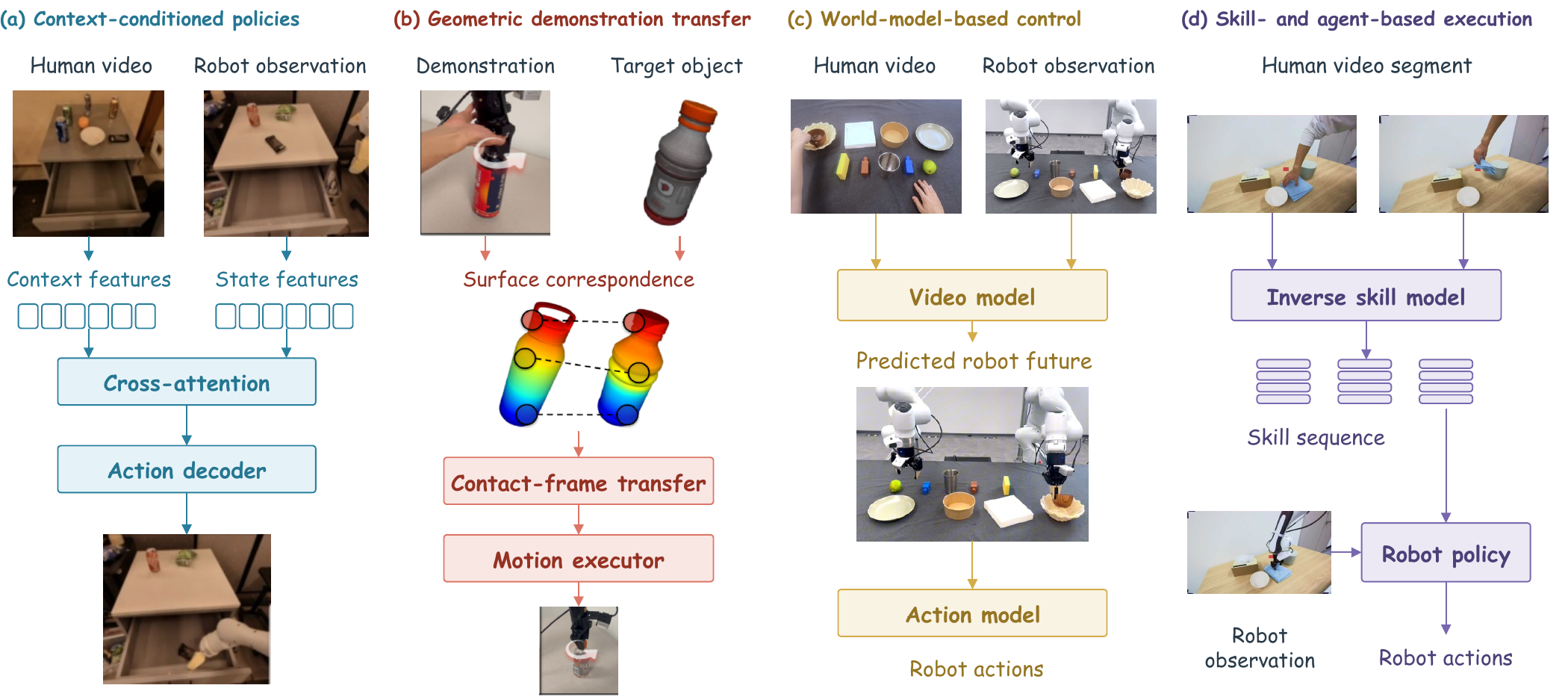
General-purpose robots must infer what a new task requires and translate that understanding into appropriate physical action. In-context learning (ICL) for robots supports this process by using demonstrations and interaction to direct existing competence with neural parameters held fixed during deployment. We organize this literature review around the interfaces connecting contextual evidence to execution, distinguishing four families: context-conditioned policies, geometric demonstration transfer, world-model-based control, and skill- and agent-based execution. Comparing these interfaces clarifies their transfer assumptions and the roles of training, correspondence, and memory in making context useful. Across manipulation and navigation, we examine how these mechanisms preserve taught requirements as objects, environments, and execution conditions change. This analysis links method design to evaluation practices that distinguish responsiveness to teaching, physical transfer, and benefits from retained experience. The agenda connects compositional transfer to active coaching and physical recursive self-improvement, where targeted teaching and verified lessons improve acquisition of subsequent tasks.
Demonstrations, instructions, and feedback guide a new task. Neural parameters stay fixed; contextual evidence directs the robot’s existing skills.
Foundations · Section 2 ↗Fine-tuning changes neural weights. Robot ICL changes the evidence available at inference: demonstrations, memory, motion references, or executable procedures.
Adaptation regimes · Section 2 ↗Vary teaching to test what was learned. Vary objects and scenes to test transfer. Compare later attempts to measure the benefit of retained experience.
Evaluation · Section 7 ↗Action inference
Demonstrations and history condition action inference. Transfer depends on preserving task requirements and mapping them to the robot’s controls.
Motion references
Spatial correspondence turns a demonstration into motion references. A controller tracks them; perception and contact changes determine transfer quality.
Predicted futures
Context predicts future observations or trajectories. Planning converts those predictions into actions that must remain physically achievable.
Executable procedures
Context composes skills, programs, and tools. Execution feedback checks progress and guides recovery when a step fails.
From learning a task to transferring it—and using experience to learn the next one better.
Identify which order, relation, or procedure is learned from teaching, and which motor skills were already available.
Preserve the taught requirement while adapting its physical realization to different objects, scenes, bodies, or dynamics.
Test whether retained experience improves subsequent learning. Distinguish contextual reuse, revised procedures, and neural updates.
Haojian Huang et al.arXiv:2609.360122026
@article{huang2026roboticl,
  title = {In-Context Learning for Robots: Methods and Applications},
  author = {Huang, Haojian and
            Li, Zexi and
            Guo, Junhao and
            Zhang, Yehang and
            Peng, Wenxuan and
            Zhou, Bohan and
            Ruan, Weilin and
            Wu, Leyi and
            Wang, Chenxu and
            Su, Jianchong and
            Xie, Binghui and
            Chen, Wosong and
            Xu, Yingjie and
            Zhou, Tianhao and
            Chen, Suzeyu and
            Zhao, Pukun and
            He, Jiaqi and
            Li, Xinyi and
            Li, Runze and
            Dong, Peiran and
            Dang, Shaoxiang and
            Huang, Jing and
            Chen, Yingbing and
            Chang, Yifan and
            Zhang, Tianyi and
            Deng, Shiyuan and
            Wang, Haozhi and
            Wei, Yangkai and
            Li, Wenqian and
            Yang, Han and
            Zhou, Kaiwen and
            Liu, Huaping and
            Cheng, James and
            Shao, Rui and
            Wang, Donglin and
            Jin, Yaochu and
            Hao, Jianye and
            Chen, Ying-Cong and
            Li, Yinchuan},
  journal = {arXiv preprint arXiv:2609.36012},
  year = {2026},
  eprint = {2609.36012},
  archivePrefix = {arXiv},
  primaryClass = {cs.RO},
  url = {https://arxiv.org/abs/2609.36012}
}